Choose embroidery if you want to slow down with thread, cloth and repeated small movements. Choose lantern making if you are curious about building and decorating a three-dimensional object. If your route already includes both Ninh Binh and Hoi An, either can fit without turning the trip into a contest between crafts. The best choice depends on what you want to do yourself, the assistance available and how the finished piece will travel home.
Compare the work, not the souvenir photograph
Embroidery introduces a way of making marks on fabric with needle and thread. A beginner session may focus on a small motif rather than a complete ambitious design. Lantern workshops can range from decorating a prepared frame to more involved assembly. Those differences matter more than the word workshop on a booking page. Ask what arrives ready-made, which steps you will perform and what happens if you do not finish.
A useful choice checklist is simple: pick needlework for patient detail; pick lantern construction for interest in shape and materials; ask for adapted assistance if fine hand movements are difficult; consider both only if learning the processes genuinely interests you. A beautiful finished object does not prove that every stage was taught, and an uneven first attempt can still represent a rewarding afternoon.
How embroidery fits a visit to Tam Coc
In the Van Lam area, embroidery gives a different focus to a stay often organized around limestone scenery. It invites attention to skill, repetition and the person demonstrating the work. Read our existing Van Lam craft article for local context; this comparison is about choosing a class, rather than repeating the village history or claiming that one activity represents all Vietnamese craft traditions.
Vị & Thêu publishes this journal and offers an embroidery workshop in Tam Coc. Treat that as a specific option to investigate, not an independent ranking. Check the current workshop page and ask about availability, language support, materials and the expected project before arriving. Leave room for a meal or rest afterward. Combining a short craft session with a boat outing can work, but only after confirming the boat and class timings separately.
How lantern making fits a Hoi An stay
Hoi An supplies a different setting: a historic trading town where a workshop can sit alongside architectural exploration and an evening walk. UNESCO's account of the Ancient Town provides historical context for the destination, not certification of individual modern classes. Choose a workshop for its actual teaching and materials rather than assuming that every lantern sold or assembled in town follows the same process.
If Hoi An is already on your route, a lantern class can be a convenient craft stop. If you are staying only in northern Vietnam, adding a long journey solely to make a souvenir is a substantial trade-off. Equally, do not add Ninh Binh solely because this journal offers embroidery. Let the wider itinerary decide the destination, then choose a meaningful activity within the time available there.
Dexterity, comfort and help for beginners
Needlework asks you to see small details and repeat controlled movements. Lantern assembly may involve holding a frame, positioning fabric and working with tools or adhesives, depending on the class. Neither description establishes accessibility. Before reserving, explain any difficulty with vision, grip, seated posture or sustained concentration. Ask whether lighting, seating, breaks and hands-on help can be adjusted. A companion can be helpful, but should not be assumed to replace an instructor.
A nervous beginner should ask to see the simplest project and how mistakes are handled. You do not need a perfect result to justify the time. A confident maker may prefer fewer prepared elements and more explanation, which should be requested before payment. Comparing two classes by advertised duration alone can be misleading: instruction, waiting, tea breaks and finishing assistance may take up different shares of the session.
With children: choose supervision before size
For a family with younger children, ask about needles, scissors, adhesives and any hot equipment actually used in the chosen class. Confirm the operator's age guidance, adult participation and instructor-to-group arrangement. Do not infer suitability from a family-friendly label or a photograph of another child. A smaller, assisted task may keep a child engaged better than a long project designed for adults.
Build in an easy exit if attention runs out. One adult might finish a project while another takes a child for a break, if the venue permits. Teenagers may enjoy choosing a design and hearing how a craftsperson develops skill, without having every movement completed for them. Ask permission before photographing the teacher or other participants, and keep other people's unfinished work out of social posts unless they agree.
Hand luggage, weather and reservations
A solo traveler carrying only a small bag should ask for the finished dimensions and packing method. Is a lantern collapsible, and will the host demonstrate folding it without damage? Is the embroidered piece supplied loose or in a frame? Neither answer is universal. Check airline or transport baggage rules separately; a workshop host cannot guarantee what your carrier will accept.
An indoor activity can be a useful rainy-day alternative, but that does not guarantee a dry journey to the venue or uninterrupted operation during severe weather. Confirm access and cancellations. Before booking, get six answers: the task you do yourself, the supported language, group size, tools and assistance, finished item and packing, and the total terms including cancellation. Then reserve the activity whose process interests you enough to enjoy even when the souvenir is imperfect.
Two practical examples to investigate
Reaching Out in Hoi An describes a folding-lantern class on its own workshop page. That is a useful example of why the finished format matters, but it does not establish the materials or inclusions at every other studio. In Tam Coc, V? & Th?u describes an artisan-guided embroidery experience on its workshop page. Compare those actual descriptions, then ask each provider for the current details that matter to you.
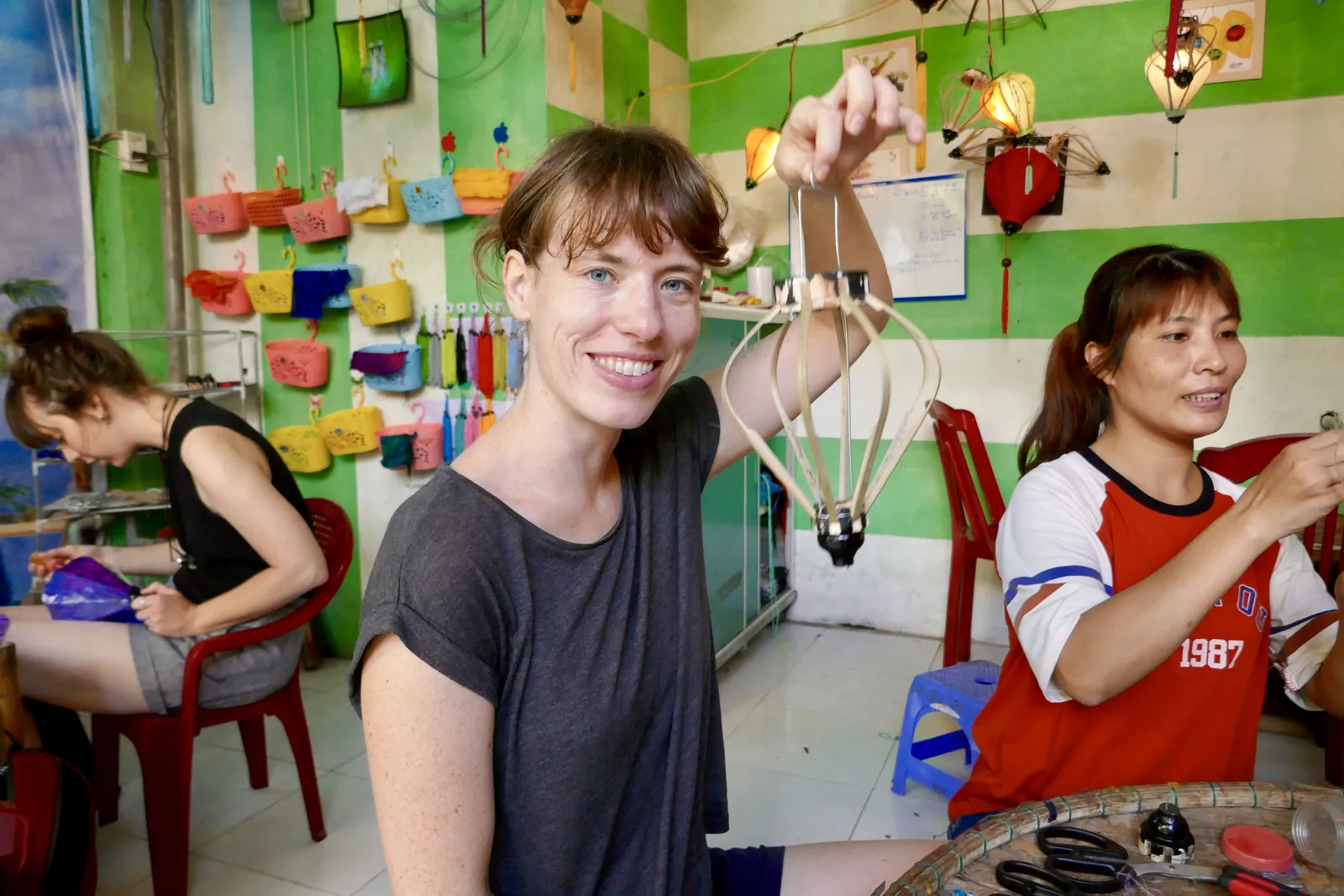
Can you simply buy a finished piece instead? Yes: if you mainly want a souvenir, purchasing one may suit your time better. A class makes sense when you value explanation and practice. Ask how to care for the object, whether moisture or crushing could damage it and what packaging is included. The photograph here documents a Hoi An lantern activity; it is not a photograph of V? & Th?u or evidence of a current provider endorsement.
Plan the next step
Sources & Further Reading
Sources checked 19 October 2026. Suggested day plans are editorial examples; confirm current access, reservations and transport directly.
Photo Credits
- Isabell Schulz — Making lanterns in Hoi An · CC BY-SA 2.0. Resized and converted to WebP; responsive display may crop. Image derivatives retain the stated license.
